Assessing science for citizenship on state science tests

For more than three decades school improvement efforts have been based on carefully aligning education goals with standards, curricula, instruction, and assessment. All elements of the education system are intended to work together in a coherent manner. For example, a report from the National Academy of Sciences observed that an important purpose of state science assessments is to “exemplify goals for student learning.”

A new paper published by the National Center for the Improvement of Educational Assessment, Testing Democracy: How Large-Scale Assessment Systems Can Support Civic Learning, builds on this idea. Authors Laura Hamilton and Christopher Brandt argue that by “making thoughtful, feasible adjustments to existing practices and frameworks” large-scale assessment systems can be agents of positive change at a time when there is widespread agreement that students need a better civics education.

We agree. In particular, state science assessments offer an excellent platform for strengthening links between science and civics. Moreover, the feasibility of doing so is demonstrated by the fact that some states already include questions on state science assessments that focus on science for citizenship. It is easy to imagine more states including such items, and also easy to see that additional test items could be developed on a multitude of topics.

As a reminder, learning science for citizenship is a concise way to reference three of the five “overarching goals” listed on page 1 of A Framework for K-12 Science Education. These goals, numbered as in the Framework, are that all students should:

    2. possess sufficient knowledge of science and engineering to engage in public discussions on related issues,

    3. become careful consumers of scientific and technological information related to their everyday lives, and

    4. develop competencies to continue to learn science outside school.

Almost all states agree that learning science for citizenship is important. For example, California’s science framework states that its goal “is to prepare California students to be future citizens and future scientists.” (An earlier post provides more information about learning science for citizenship.)

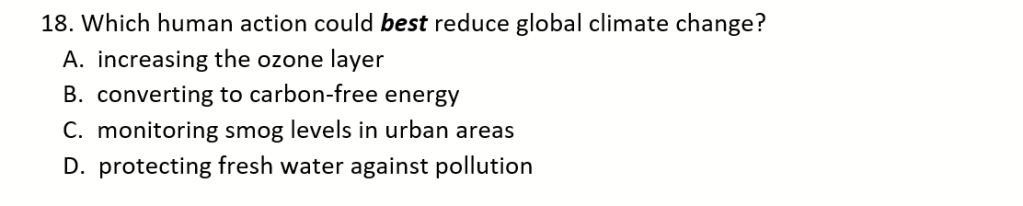
What might test items look like that correspond to these three goals? Colleagues Virginia Snodgrass Rangel, Jocelyn Miller and I have found multiple examples on a few state science tests. For example, here is an item from North Carolina’s 2025 high school biology test that focuses on Goal 2 (being prepared to discuss public issues related to science and technology):
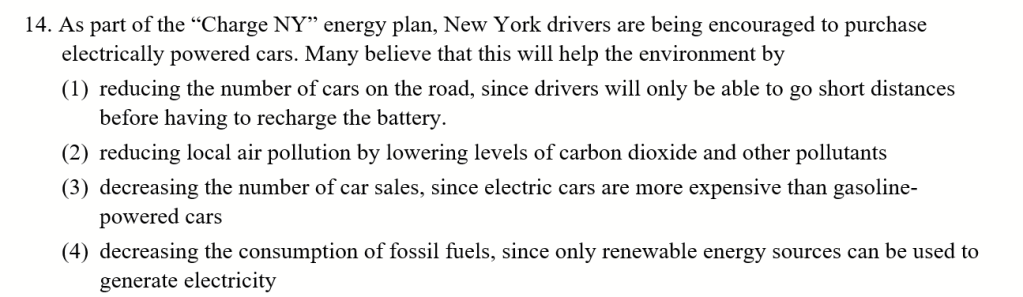
An item from New York’s 2025 high school biology tests focuses on the same goal about public issues but in a different way:
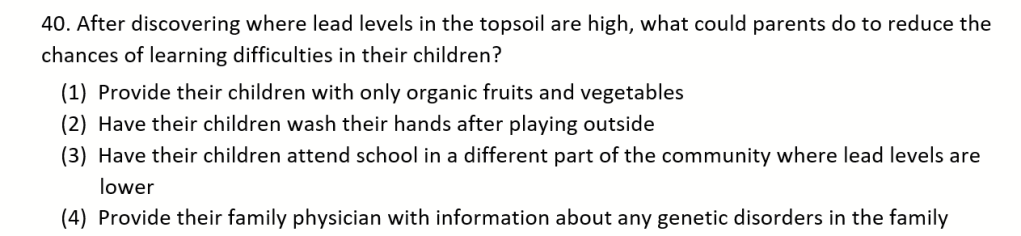
We also found test items that primarily focus on Goal 3 (learning to use knowledge of science and technology to become careful consumers), such as this one from the New York test:
It is encouraging to find such items because Goals 2 and 3 are important. Students will benefit from supervised practice using science—along with ethics, economics, and other considerations—as they analyze choices to make thoughtful decisions.

Yet Goal 4, developing competencies to continue to learn science outside school, is arguably the most important part of learning science for citizenship because people won’t reliably make good decisions related to public issues or to using science in their everyday lives unless they learn how to evaluate sources and find trustworthy science-related information. Learning competencies related to Goal 4 is the same as developing students’ science media literacy, a goal that is advocated by the National Science Teaching Association and the National Association of Biology Teachers, as well as by an increasing number of states. Importantly, research shows that providing appropriate instruction can help young people better evaluate science-related information (e.g., Axelsson et al., 2021).

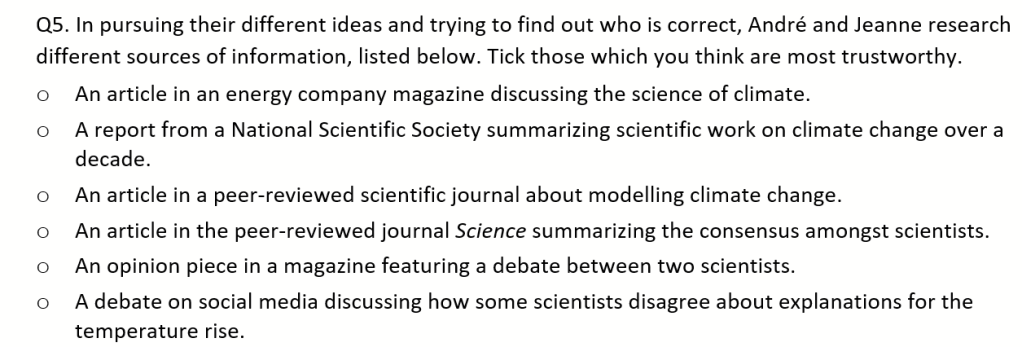
However, my colleagues and I are not aware of any state science test questions that specifically assess Goal 4. Feasibility is not a barrier, as demonstrated by the fact that PISA will be assessing what they call “competency 3,” measuring students’ capacity to analyze, evaluate, and interpret claims and arguments from different sources to draw evidence-based conclusions related to science. In effect PISA will be assessing Goal 4.

Here is an example of a released PISA item that focuses on learning science outside school, i.e. science media literacy. This one is part of a sequence of questions about the emission of carbon dioxide and its relation to global warming:
Drs. Rangel, Miller and I will submit a manuscript to a peer-reviewed journal reporting our findings about state science tests and discuss them in a broader context. Although our work is not done, we have already found that some states do not include any questions about learning science for citizenship even though their standards say that is an important goal.

Substantial research demonstrates that the nature and structure of assessments drive what gets taught (e.g., Au, 2007) and that teachers feel pressure to ensure their students perform well (Emler et al., 2019). One implication of our findings to date is that we see significant opportunities for states to use federally mandated science assessments to reinforce for teachers, students, and the public that learning science for citizenship is a core goal for K-12 science education and therefore an outcome that should be tested to “exemplify goals for student learning.”

A new article about reinventing science education standards

The Journal of Research in Science Teaching published an excellent article in September called “Reinventing science standards to better support meaningful science learning.” This post discusses strengths of that paper and identifies missing pieces of what colleagues and I believe is needed to reinvent the standards, including revising standards to help students better evaluate information and thereby resist scientific misinformation (e.g., “vaccines cause autism”). The paper is open source, i.e., not behind a paywall, and is available HERE.

The authors, Jeffrey Nordine and David Fortus, make a well-reasoned, carefully documented, and comprehensive argument that current science education standards in many nations, notably the NGSS in the U.S., are poorly aligned with learning theory. In other words, the current standards are unlikely to motivate students to learn science. This is an argument that colleagues and I have been making, too, using different sources and rationales. As a reminder, NAEP recently reported that only 39% of American eighth-graders reported they were interested in their science class.

The fact that an independent analysis points to an identical conclusion to ours, namely that current science education standards lead to instruction that is failing to engage students, is noteworthy. The new article cites a wide variety of papers and reports related to learning theory to support their reasoning and conclusions. The comprehensive set of references, more than 100 in all, is a strength of the paper. To choose just one example of how the article presents clear arguments with supporting citations, the authors write:

“… when learners do not perceive a meaningful purpose (meaningful for them) in the tasks in which they are expected to engage, their motivation to engage with these tasks will decline, and they will be less likely to construct significant new knowledge (Ames 1992; Dweck 1986; Fortus and Touitou 2021).”

Another significant feature of the paper is its recommendation that science education standards should be organized “according to contemporary issues and contexts rather than disciplinary content ideas.” That conclusion echoes part of a recent post on this blog about Pennsylvania’s new science education standards (STEELS), which reads: “I am confident that there are creative ways for other states to incorporate ‘contexts’ into their standards, as Pennsylvania has done.” Nordine and Fortus’s conclusion is also similar to the call that NSTA made years ago in a Position Statement called Teaching Science in the Context of Societal and Personal Issues, which colleagues and I have often cited. Teaching science in contexts that are relevant to students’ current and future lives is engaging because it is meaningful to them.

I welcome Nordine and Fortus’s excellent paper, which is convincingly backed by prior research. However, there are three important ways in which the article falls short, in my opinion. Each of these perspectives provides an additional reason to reinvent science education standards, as well as rationales for the needed changes.

First, as colleagues and I have documented before, there is a misalignment between the admirable goals laid out in A Framework for K-12 Science Education and the NGSS standards that were supposedly based on the Framework. Teaching and learning science for citizenship is almost entirely missing from the standards—but it is succinctly summarized in three of the five goals identified on page 1 of the Framework. Those three goals for all students are: possess sufficient knowledge of science and engineering to engage in public discussions on related issues; become careful consumers of scientific and technological information related to their everyday lives; and, develop competencies to continue to learn science outside school. Together, these goals can be seen as an excellent definition of learning science for citizenship.

Nordine and Fortus seem to confuse understanding science in the way that scientists practice science (in other words, science as described in the NGSS standards) with using science as a citizen uses it. For example, scientists conduct research to understand climate change and use science to develop green energy sources, such as wind turbines. Citizens, on the other hand, do not need to know science in the way that scientists do in order to identify candidates who are concerned about climate change, or weigh the costs and benefits of purchasing an electric vehicle, or decide whether to install solar panels on their home. Furthermore, these decisions require knowledge of information outside the domain of science, whether to weigh benefits versus costs, or to consider the ethics of one decision or another. If learning science for citizenship is an important goal, science education needs to be reinvented to help young people learn about and practice making decisions in their everyday lives as citizens, including as future voters and consumers—decisions that involve science but that are not limited to the perspective of a scientist who is “doing” science.

That raises the second way the article falls short. We agree that the goal of reinvented science education standards should prioritize “students’ ‘informed agency’ over ‘competence,’” as the the paper’s abstract says. We seem to differ, however, about the meaning of ‘informed agency’ in the context of science education. Few students will become scientists or use science, as described in standards, in their jobs. Having some understanding of science in the way that the NGSS standards suggest is a worthy goal but the balance is wrong. Students also need ‘agency’ to make societal and personal decisions that use science but are not equivalent to doing science.

It is not enough to organize science education standards “according to contemporary issues and contexts” if what that means is studying the science behind drinking water purification, or the global greenhouse effect, or pandemic diseases like COVID-19, as the authors suggest. Again, that perspective has value, but only to a point. Reinvented science education standards should also be organized around decisions that ordinary citizens need to make. How should I decide whether to buy bottled water instead of using tap water (which may be contaminated)? What are the costs and benefits of a carbon tax or fee, and should I support one in my state? Is it true that vaccines contain dangerous substances and therefore I should avoid being vaccinated or having my child vaccinated?

Reinvented standards need to put a higher priority on making informed decisions that do not rely on “doing” science. Furthermore, CRISPR, artificial intelligence, robotics and other science-based technologies pose ethical questions that an educated citizenry needs to understand for democracy to function well—knowledge that is not the same as understanding in any detail the science behind these technologies.

That brings us to the third way the article falls short. This is an age of scientific misinformation that is having serious negative impacts, such as falling vaccination rates. We agree with Nordine and Fortus, and with the Framework, that learning how to continue learning science outside of school is critically important. To achieve that goal requires what has been called science media literacy. What is a “scientific consensus” and is this particular claim based on such a consensus? Who is behind a claim that I encounter? What do others say about that claim? Which people or organizations are qualified to make judgments about such a claim allegedly based on science? Who should I trust and why? Reinvented science education standards need to place a much higher priority than the NGSS on learning how to evaluate claims allegedly based on science, which students will encounter throughout their lives, including claims about diets, nutrition, mental health, and other topics we cannot predict and cannot yet teach. These are vital competencies in a science-based world.

In summary, the Nordine and Fortus paper is a valuable and much-needed contribution to the science education literature. Their major conclusion, which is that current science education standards promote instruction that does not align with learning theory, and that therefore fails to adequately engage a majority of students, is important and we believe it is correct. Reinventing science education standards along the lines they suggest, with the addition of the perspectives described above, would result in greater student engagement in K-12 science education and would contribute to an increasingly scientifically literate population, as more broadly defined than in the current standards.

Note: This entire blog can be downloaded as a single PDF file. See the link at the bottom of this page.

A case study of revising Pennsylvania’s science education standards

State science education standards can differ significantly from one another, and state standards are what directly affect science teachers, students, principals, and others. The states’ decisions are important, yet they are not well studied or understood.

A case study of the development of new science education standards in Pennsylvania, STEELS, is now available that may be useful as other states revise their standards. I did not want to include too many of my own opinions in the paper, focusing instead on the story in Pennsylvania. But there are useful lessons for other states, and to that end, here are a few additional reflections.

One of the ideas that was new to me and has potential in other states is to specify “contexts” in which certain performance expectations are important but that also allow teachers the flexibility to choose examples within those contexts. For example, two of the eight contexts in which technology and engineering standards are taught in Pennsylvania are “Computation, Automation, Artificial Intelligence and Robotics” and “Medical and Health-Related Technologies.”

Not only does the use of “contexts” put fewer handcuffs on science teachers (“teach exactly this”), but it also has a better chance of allowing curriculum and instruction to change, without revising standards, even as 21st century science and technology continue to change at a rapid rate. If students need to learn more about pandemics and vaccines, or about the benefits and risks associated with artificial intelligence, or about computer chips, teachers should not need to wait decades for science education standards to catch up and be revised. I am confident that there are creative ways for other states to incorporate “contexts” into their standards, as Pennsylvania has done.

Another important lesson learned is about the goals for science education. One need only read current newspaper headlines to realize how important it is that American students learn “science for citizenship.” A Framework for K-12 Science Education spells this out very well, specifying five “overarching goals” for science education, only one of which is to prepare students for college and careers. Three other goals for students in the Framework are: possessing sufficient knowledge of science and engineering to engage in public discussions on related issues; becoming careful consumers of scientific and technological information related to their everyday lives; and developing competencies to continue to learn about science outside school (e.g., media literacy skills to better evaluate information supposedly based on science). States need to write performance expectations that reflect these broader goals and Pennsylvania’s new standards are at least a small step in the right direction.

The Next Generation Science Standards spells out contradictory goals, as do many state science education standards. On the one hand, standards claim to be promoting “science for citizenship,” a goal that science teachers and their professional organizations strongly support (see the preceding post). On the other hand, the NGSS specifically states that the goal of the standards is far narrower, namely, to prepare students for college and careers. Pennsylvania’s STEELS standards seem to do a better job supporting the goal of teaching science for citizenship than most states do. Others should take notice.

Note: This entire blog can be downloaded as a single PDF file. See the link at the bottom of this page.

Additional note: To my surprise, an excellent video presentation of my paper was created using Google’s NotebookLM. It is shocking how good the video is, complete with images and narration, and especially because it takes little more than the push of a button to create these from any source, or sources. The YouTube video is HERE.