For more than three decades school improvement efforts have been based on carefully aligning education goals with standards, curricula, instruction, and assessment. All elements of the education system are intended to work together in a coherent manner. For example, a report from the National Academy of Sciences observed that an important purpose of state science assessments is to “exemplify goals for student learning.”
A new paper published by the National Center for the Improvement of Educational Assessment, Testing Democracy: How Large-Scale Assessment Systems Can Support Civic Learning, builds on this idea. Authors Laura Hamilton and Christopher Brandt argue that by “making thoughtful, feasible adjustments to existing practices and frameworks” large-scale assessment systems can be agents of positive change at a time when there is widespread agreement that students need a better civics education.
We agree. In particular, state science assessments offer an excellent platform for strengthening links between science and civics. Moreover, the feasibility of doing so is demonstrated by the fact that some states already include questions on state science assessments that focus on science for citizenship. It is easy to imagine more states including such items, and also easy to see that additional test items could be developed on a multitude of topics.
As a reminder, learning science for citizenship is a concise way to reference three of the five “overarching goals” listed on page 1 of A Framework for K-12 Science Education. These goals, numbered as in the Framework, are that all students should:
2. possess sufficient knowledge of science and engineering to engage in public discussions on related issues,
3. become careful consumers of scientific and technological information related to their everyday lives, and
4. develop competencies to continue to learn science outside school.
Almost all states agree that learning science for citizenship is important. For example, California’s science framework states that its goal “is to prepare California students to be future citizens and future scientists.” (An earlier post provides more information about learning science for citizenship.)
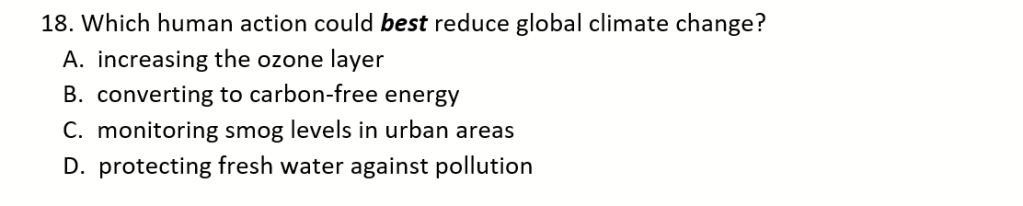
What might test items look like that correspond to these three goals? Colleagues Virginia Snodgrass Rangel, Jocelyn Miller and I have found multiple examples on a few state science tests. For example, here is an item from North Carolina’s 2025 high school biology test that focuses on Goal 2 (being prepared to discuss public issues related to science and technology):
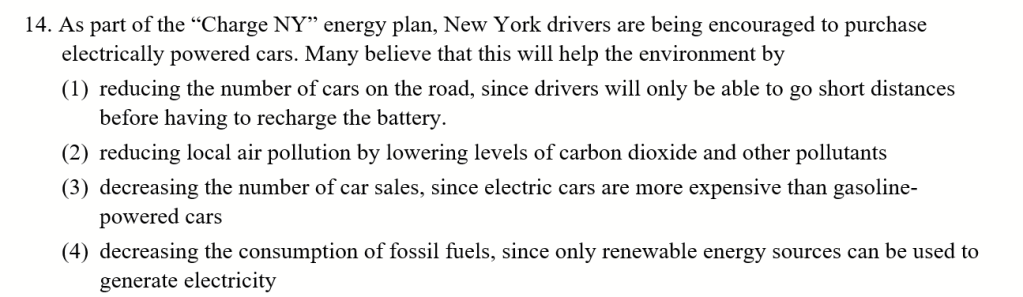
An item from New York’s 2025 high school biology tests focuses on the same goal about public issues but in a different way:
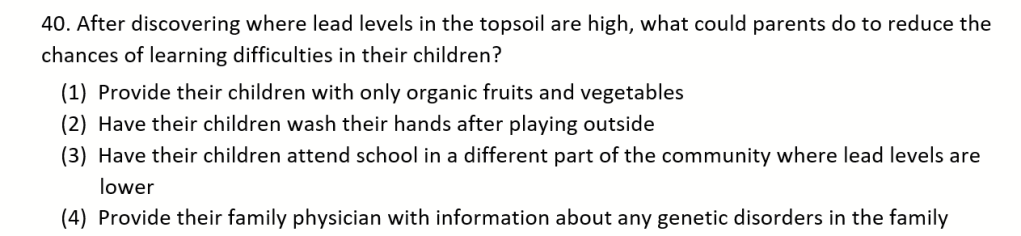
We also found test items that primarily focus on Goal 3 (learning to use knowledge of science and technology to become careful consumers), such as this one from the New York test:
It is encouraging to find such items because Goals 2 and 3 are important. Students will benefit from supervised practice using science—along with ethics, economics, and other considerations—as they analyze choices to make thoughtful decisions.
Yet Goal 4, developing competencies to continue to learn science outside school, is arguably the most important part of learning science for citizenship because people won’t reliably make good decisions related to public issues or to using science in their everyday lives unless they learn how to evaluate sources and find trustworthy science-related information. Learning competencies related to Goal 4 is the same as developing students’ science media literacy, a goal that is advocated by the National Science Teaching Association and the National Association of Biology Teachers, as well as by an increasing number of states. Importantly, research shows that providing appropriate instruction can help young people better evaluate science-related information (e.g., Axelsson et al., 2021).
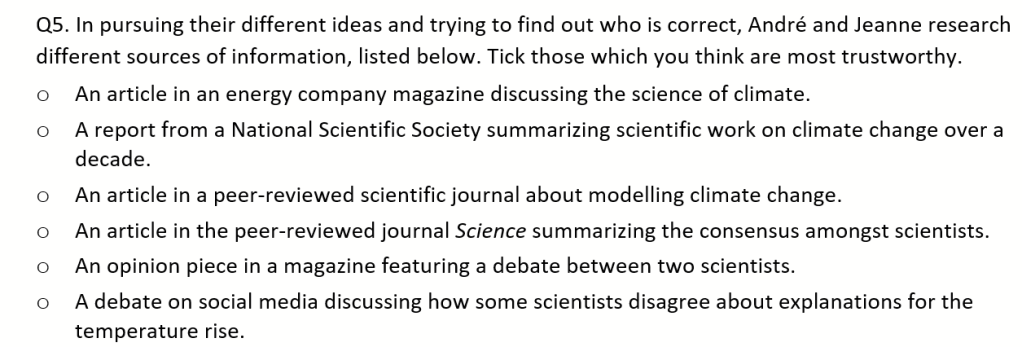
However, my colleagues and I are not aware of any state science test questions that specifically assess Goal 4. Feasibility is not a barrier, as demonstrated by the fact that PISA will be assessing what they call “competency 3,” measuring students’ capacity to analyze, evaluate, and interpret claims and arguments from different sources to draw evidence-based conclusions related to science. In effect PISA will be assessing Goal 4.
Here is an example of a released PISA item that focuses on learning science outside school, i.e. science media literacy. This one is part of a sequence of questions about the emission of carbon dioxide and its relation to global warming:
Drs. Rangel, Miller and I will submit a manuscript to a peer-reviewed journal reporting our findings about state science tests and discuss them in a broader context. Although our work is not done, we have already found that some states do not include any questions about learning science for citizenship even though their standards say that is an important goal.
Substantial research demonstrates that the nature and structure of assessments drive what gets taught (e.g., Au, 2007) and that teachers feel pressure to ensure their students perform well (Emler et al., 2019). One implication of our findings to date is that we see significant opportunities for states to use federally mandated science assessments to reinforce for teachers, students, and the public that learning science for citizenship is a core goal for K-12 science education and therefore an outcome that should be tested to “exemplify goals for student learning.”

